Friday, 25 November 2011
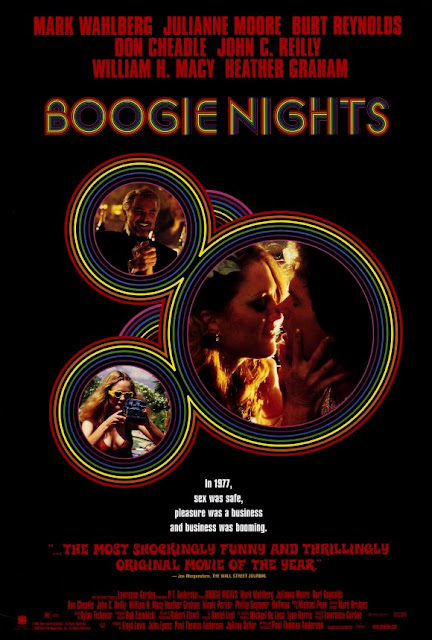
Boogie Nights (1997) Directed by P. T. Anderson
Astrid:
Boogie Nights and Magnolia are not only directed and scripted by the same guy, P. T. Anderson, they have mostly the same cast too. The two films are eternally linked in my mind. Like Magnolia, so Boogie Nights had a relatively huge impact on me growing up. Their shared and pessimistic outlook on life in general seemed real to me then. I did not see it as overly dramatic. Also, the fact that Boogie Nights deals with the beginnings of the porn industry as we know it, is important and was crucially overlooked by me in the past.
The way I remember the film and the way I experienced it now are two very separate perspectives: The porn film making content, the always naked women, the drugs and the eventual judgment the film appears to pass were all one big teaching video for the teenage-me. Instead of feeling uncomfortable and critical towards the way women were in Boogie Nights, I felt uncomfortable and as if this was a here's-how-to guide. It is baffling to realize how much a teenager watches a fictional piece of art and reads it as a lesson on Real Life, Real Sex and Real Relationships. I think I came out of seeing this one for the first time thinking something like: 'ok, cool women are available and enjoy sex with anyone at any time, they drown their sorrow into silence and always look good no matter what.'
This time around Boogie Nights seemed tame as well as overly dramatic, unnecessarily violent, shallow, pretentiously sad and mildly dated. I sensed no pressure from the film, it was not suggesting ways of being anymore. I felt also that Anderson was possibly playing with too simplistic stereotypes about porn. It may be that the director was being judgmental, looking down on people who make porn their occupation. He even mixed the issue of child porn and molestation with adult porn thus making the old-fashioned 'cigarettes lead to drug use and porn to crime' -claim. If I'm honest, this time I was a little bored and not very entertained.
Nick:
Do you remember a time when people thought Fionna Apple was somehow the musical zeitgeist? It correlates with a time when P.T.Anderson was regarded as the savior of modern cinema. This feels oddly conservative to me. But I think it's true to say of most things that seem cutting edge at the time, when we look back, we realize it was just more of the same. Apple seems to have disappeared into some vacuum. With Punch Drunk Love and There Will Be Blood Anderson seems to have passed his fan-boy period and shows signs of becoming that predicted savior. Bloody hell, the then approaching pre-Millenium 1990's, remember that time? One could be mistaken for thinking that Anderson as well as savior, perfectionist and friend of Aimee Mann was also the oracle, as demonstrated by the consciously "intelligent" Magnolia of 1999. Boogie Nights placed Anderson on the map and made him hot hot hot.
There is no way round this, but to not note the specific influence of Scorsese on Boogie Nights is to miss something crucial with the picture. From the use of long camera shots and fast editing to the constant 1970's soundtrack, Boogie Nights stylistically is the work of another director. It's second hand goods watching Boogie Nights (primarily Goodfellas, Raging Bull, Casino). Rather like the debt to Altman on display in Magnolia. It doesn't stop Boogie Nights being a blast at times. The first hour is a non stop disco ride of good looking men and women "getting it on" on the dance floor or in front of camera. The picture has energy. Excellent scene after scene is readily crafted here (especially the 1970's period), every detail shot to perfection. The ensemble cast (many would re-appear in Magnolia) is universally excellent. Burt Reynolds surprises with his smoothness and sometimes sensitivity. Still, you do have to wonder what Julian Moore has done to Anderson for him to always have her play such desperate characters in his pictures. But this brings us to another element which constantly raises it's head in Anderson's early films : depression.
The second half of Boogie Nights is depressingly drawn out. Characters we don't really connect with or know suddenly find themselves in life changing situations. Simultaneously, Anderson does not deal in any depth with the porn industry of the 1970's (a far more interesting movie awaits). So, Anderson digresses by having his main protagonist, exceptionally well endowed porn star Dirk Diggler (Mark Whalberg) descend into a cliched portrayal of drug abuse. It made me yawn. Two excellent scenes come out of this malaise : Dirk Diggler's attempted early 1980's music career (after turning his back on the porn industry) and the later drug exchange with Alfred Molina's Rick Springfield obsessed druggie.
Moments like this make Boogie Nights worth it, just. It's a long movie that outstays it's welcome. Anderson decides in the end that everything really does turn out OK and hell, we all need some kind of family. So, this can be a frustrating film, which is also occasionally brilliant.
Saturday, 19 November 2011
Ghost World (2001) Directed by Terry Zwigoff.
Nick:
Last weeks news of famous comics scribe Frank Miller, spewing right-wing dogma against the Occupy movement wasn't so surprising. His seminal and groundbreaking The Dark Knight, Daredevil and Sin City graphic novels re-imagined noir for a new generation with some added, subtly fascist undertones. Unfortunately, recent works have shown a drop in standards, followed by a drop in popularity. Controversial seems a surefire way to get attention, and maybe Miller can try to hide the fact that he had anything to do with directing The Spirit by spouting off some outrageous comments. It's fair to say that Miller is responsible (along with a handful of other writers) for breathing life back into some legendary superhero franchises some 20 odd years ago with the graphic novels boom. Around this time another kind of writer emerged within the comics culture. Daniel Clowes, creator of Ghost World, ushered in a more literary approach to comics. As opposed to dealing with the superhero variety, Clowes creates worlds that are slightly twisted and surreal. Grotesques, 1960's pop-culture and the suburban slacker malaise feature in Clowes distinctive visions.
Zwigoff, working from a Clowes script, captures the essence of the comics whilst fashioning some great performances along the way. Not only this, Ghost World works as a slightly surreal love story. Thora Birch (who I'd completely forgotten about after American Beauty) and Scarlett Johansson star as the two high school outsiders (Enid and Rebecca) who decide to move in together after graduating. In many ways, Ghost World does work as a rites of passage movie between two close friends as they make their way into the real world. But that does make the picture sound too simplistic, when what's on offer is never obvious.
Steve Buscemi playing the loser-in-love Seymour who is the subject of a practical joke from Enid and Rebecca ignites Ghost World. The endless walking the streets and checking the freaks turns (at least for Enid) into forbidden love. After the practical joke, Enid falls for Seymour, probably because there's nothing better to do. Twigoff (well know for some ace documentaries such as Crumb) strikes the right chord with Ghost World. Not only does he make you laugh, but he creates something original with the film, without cheapening Clowes initial inception. Birch is really good here (although the yet-to-be-star Johansson will probably be the reason why people find this now). Ghost World is for once a great graphic novel adaptation.
Astrid:
I watched Ghost World with curiosity and dread. I wished the two young women would not be too hurt by what life had in store for them. At the same time, I was tickled by their daring and a little bit over-the-top manners, their sense of superiority in relation to their peers and their parents, their outfits full of expression and their growing difference in how they experienced life as well as what they expected from it.
I have been one of those girls. Maybe not just Enid or Rebecca, but a mixture of both. I have also been one half of a such close union of two girlfriends. Watching Ghost World reminded me of a time that was simultaneously very uncomfortable and very potent with a sense of becoming. Life was pure potential, all doors seemed open and I had complete trust in the world, even if I could make sarcastic remarks on its inevitable doom. This time was spent with great girlfriends, talking big dreams, planning to live together, borrowing each other's clothes and talking about men, the future, sex, the futility of education and a lot of important matters that completely escape my mind now.
I watched Ghost World with curiosity and dread. I wished the two young women would not be too hurt by what life had in store for them. At the same time, I was tickled by their daring and a little bit over-the-top manners, their sense of superiority in relation to their peers and their parents, their outfits full of expression and their growing difference in how they experienced life as well as what they expected from it.
I have been one of those girls. Maybe not just Enid or Rebecca, but a mixture of both. I have also been one half of a such close union of two girlfriends. Watching Ghost World reminded me of a time that was simultaneously very uncomfortable and very potent with a sense of becoming. Life was pure potential, all doors seemed open and I had complete trust in the world, even if I could make sarcastic remarks on its inevitable doom. This time was spent with great girlfriends, talking big dreams, planning to live together, borrowing each other's clothes and talking about men, the future, sex, the futility of education and a lot of important matters that completely escape my mind now.
Ghost World is not a very happy and funny movie. Yet, it is a kind of comedy and though it’s pretty realistic, there is something fairytale like in the movie. The film has a touching and serious side to it. Thankfully, it treats the two young women with respect instead of saying ’look at them they are freaks’. I’m amazed I haven’t seen this before. I would recommend this to a teenager, although am not sure how I would have responded to it at the ripe age of 16 or 17.
Wednesday, 16 November 2011
Unforgiven (1992) Directed by Clint Eastwood
Astrid:
Unforgiven, the word itself has multiple meanings and directions in Unforgiven. In fact forgiveness is something the characters in this story have very little of. The prostitute women in town will not forgive the man who mutilated one woman's body. The men of the town will not forgive the women for ordering the mutilator to be killed by an outside killer and the women of the town will not forgive the men for not killing the man themselves. There is no forgiveness, just appropriate degrees of revenge. It's a game of survival.
Clint Eastwood's elderly farmer has a dark past which he does not forgive himself. He does not forgive the village for their inability to protect their own women and no one forgives him. He has been a changed man for years, bringing up his children in poverty nearby his dear wife's grave, but to the outside world he is always the ruthless killer that scared everybody even if they just heard his name mentioned.
Unforgiven describes a world where justice does not get protected by the law or a sheriff, even though these institutions exist. People are guided by their individual morality, they are alone seeking for their rights to exist. Revenge is a a logical mechanism in a climate where forgiveness is a life-threatening utopia. Really, in this scenario to forgive would mean to surrender and to give up one's life rights.
Forgiveness was a luxury in the Wild West. But can we still claim that today?
Nick:
People's perceptions of who you are rarely change, even when presenting evidence contrary to hard worn belief. It's a natural conclusion one can draw, it's especially relevant when discussing celebrity, we are after all lazy beings. Take Clint Eastwood. The perception people still have of Eastwood is the liberal conservative toting a big gun. He's popular (immensely) and his hard, iconic on-screen persona has betrayed his talent as one of the great mainstream film directors of the last 40 years. Of course, this perception has changed slightly over recent years (with Oscars comes respectability), but he'll always be remembered for the "make my day" line. I could argue that prior to Unforgiven (the movie that made him welcomed by the movie establishment), Eastwood had directed some unfussy and occasionally brilliant movies. Personally, he's yet to better The Outlaw Josey Wales, in not just Western terms, but as a piece of cinema in any genre. It's one of my favorite films ever and the fact that I rate Unforgiven close to it, should give you advance to some of my feeling here. Unforgiven also has a bonus as being Eastwood's best on-screen turn.
I grew up in Staines, and I do recall going to see Unforgiven at the local cinema on release. That old cinema went years ago, a multiplex nowadays supplying the local public their celluloid thrills. I do remember that the cinema housed all my growing movie experiences. I remember going alone to see Unforgiven and some 3 other people being in the cinema with me. In isolation, Unforgiven was a majestic beast that validated those of us that knew Clint was the man. My opinion hasn't really changed. I've watched this film so many times. It's slow to unravel, intense, and occasionally reveals gentle mocking humor. Eastwood always uses natural light which means the look of the film has just got better over time. All the performances are standout, especially Morgan Freeman and Gene Hackman. But Clint waited to play this role, he knew he had to be the right age. Yes, there's echoes of Henry Fonda here, but it's The Man With No Name referencing his own past, specifically High Plains Drifter and the Preacher from Pale Rider, Eastwood's William Munny in Unforgiven could be these same charters a few years down the line.
So this is the deal. We get Eastwood debunking his own iconic screen persona of the previous 30 years for most of Unforgiven. He's trashing The Man With No Name and the callous violence of Dirty Harry and countless other cool shoot'em ups. Eastwood has pursued this theme for a lot of his post Unforgiven pictures (Mystic River, Letters From Iwo Jima), this was a turning point. Eastwood shows us the futility of taking someone's life, the key line in the movie, delivered by Eastwood's rejuvenated Munny being:"It's a hell of a thing, killing a man. Take away all he's got and all he's ever gonna have." But Eastwood can't leave it alone. The thrilling last 20 minutes of Unforgiven remains some of the most intense cinema I've seen. Eastwood's scraggly features redefine for us his screen persona and deliver the ultimate vengeful angel of death. It's hardness unparalleled combined with a laconic cool only Eastwood's iconic cowboy persona can deliver. It's the soul of Unforgiven and it's unmissable.
Saturday, 12 November 2011
ER: Season 1 (1994)
Nick:
So, this week: the environment is well and truly shafted, the Eurozone is well and truly shafted, the white & black rhinos are well and truly shafted and Republican candidate Rick Perry is well and truly shafted, but he probably doesn't remember why. It's not as if any of these things have impacted on my life – yet. As the days get stupidly short in Finland it feels like the news grows equally darker and more depressing. On top of this, we've been rattling through the first season of ER. Somehow I have managed to miss ER. I've caught a few episodes over the years, but Michael Crichton's celebrated Emergency Ward series is a mystery to me, especially these early one's with George Clooney.
ER is famous for taking the hospital drama into a more realistic direction than home audiences were used to (although M*A*S*H certainly didn't spare the blood or the political/social commentary in the 1970's). ER is mostly focused on the emergency ward of a Chicago County General Hospital and with the young resident surgeons and doctors who treat patients under the most trying circumstances and in never ending shifts. Scenes are gritty and technical yet over the course of Season 1 we get to know the key characters intimately. The main cast of Anthony Edwards, George Clooney, Noah Wyle, Sherry Springfield and Eriq La Salle are all excellent. As the season moves on we get more personal with each central character and their lives away from the ER, but it's the hospital where ER excites and, at times, traumatizes.
Yes, ER can be a massive downer. It can also be sentimental and George Clooney can be the smarmiest arse. But this is minor. ER is top TV series fodder. It has been incredibly popular and holds all sorts of records. I've heard the standards of the first season were maintained throughout it's 15 (!!!) seasons. If so, it's deserved its success. I cant wait to tuck into Season 2.
Astrid:
When I was an exchange-student in Michigan in 1999, my mother based her idea of what my surroundings were like on ER. Sure, I went to Chicago once with a symphony orchestra of teenagers to play a show at a Hilton hotel downtown, but other than that my life was nothing like the characters' in ER and Chicago remained a stranger to me. I came to ER later, possibly when I returned back to Finland in 2000 and my mother was still watching the series because it was so good. I remember being surprised that my mother liked a show about a hospital emergency room with doctors and nurses as the main characters and with a lot of fast paced technical talk and blood.
ER ran on Thursdays in Finland. It went on for years and so when I had moved out from my parents' to live with Nick, I continued to watch it. Or actually that's when I began to really follow it. The characters became people I really cared for – I cried every Thursday on my own while watching ER, because Mark was dying and Carter was going to Africa and patients died and the women were often so unlucky in love...The important point is: I was always home alone on Thursdays when ER was on.
During the resent months my taste in entertainment has narrowed to accommodate the pregnant brain and emotional state. Yet, I was surprised to find myself needing to watch ER again. Surely it would be too gory and heavy...people dying and being born all the time...But I wanted to start from the beginning and share ER with Nick, who was always working on Thursdays back when we still had a TV.
ER: Season 1 did not disappoint. Even when the series is nearing its 20th birthday, it doesn't seem dated. I guess that's because it deals with such fundamental issues and everyone's wearing a white, green or pink doctor's coat, which don't seem to change in look ever. One of ER's best features is that it is easy to insert oneself into the series and therefore reflect on my own life. There's always something familiar there: some experience, fear, situation or a character to empathize or identify with. Still makes me tearful and wanting more.
Sunday, 6 November 2011
The Adventures of Tintin: The Secret of the Unicorn (2011) Directed by Steven Spielberg
Astrid:
I believe that me never becoming very fascinated with comic books as a child was to do with what I was offered. I was given the world of Astrid Lindgren and Tove Jansson, the visuals of Rudolf Koivu and Carl Larsson. The outlines and block-colors of Donald Duck were foreign to me and I didn't even know what order to read the comic book boxes in. I did have a Tintin book though. It was from my father's childhood and I read it many times, even when I did not know my ABC.
There was something about Tintin that seemed slightly adult, over-my-head, sophisticated and yes indeed, fascinating. Tintin was a boy in adventure, but he was also an intelligent journalist (which I must have not really understood for a long time) and his friend Milou/Snowy added an endearing touch. My distant affection for Tintin has survived to this day and it now led me to the opening night of The Adventures of Tintin in 3D. It was my first time wearing 3D glasses and let me warn people with glasses: it's not a fun combination to wear two pairs on top of each other for two hours. Next time I'd prepare by wearing contact lenses underneath. My initial shock of seeing things in 3D felt a little like it must have felt for people a hundred years ago when they first drove a car. Sadly, this exhilaration wore off quickly and was replaced by a feeling that the film really didn't need to be in 3D at all.
Having freshly viewed all 3 first Indiana Jones films I must say that at times Spielberg's Tintin veered very close to Indie-like-action-filler. That's my criticism of an otherwise entertaining and great looking fairytale. The style of animation used in the film seems to aim at mixing very realistic human features and movement to very fantastic and unreal scenarios. I'm not convinced all this fancy technology is necessary for a good movie experience, or for a good story. The success of a fairytale is so much down to our own imagination. Nowadays it looks like adults are making children's movies prioritizing the advances in technology over our capacity to imagine. Yet the kids love their movies, I know. But why the hell does the theater turn up the sound so much we have to block our ears in the fighting scenes?
Tintin is still good and intelligent though, Haddock's alcoholism is an interesting topic rarely openly discussed in a film for kids and Milou is a genius.
Nick:
It has been fascinating the last few weeks reading Tintin experts (yes they exist), spouting forth all kinds of nonsense about how violated they feel by Spielberg's movie. The Guardian newspaper especially seems to have a vendetta against the film, as article after article spouts on about how rubbish The Adventures of Tintin is. Personally, I've found some of the claims made on behalf of Hergé's creation really ridiculous" "Greatest comic strip ever" (calm it!) "deep, hidden layers of meaning" (patronizing or what?) It's amazing, but I'm pretty sure most of these Tintin experts are white, middle class and middle-aged males who as well as obsessing over Tintin, probably masturbate over the thought of the Hubble Telescope. Getting a life has a lot to do with it. I'm a Tintin fan, I've read the books (ages ago), I used to love the old TV cartoon series as a child and even the very confused 1960's movie adaptations. Spielberg's Tintin (produced by the Lord Of the Rings guru Peter Jackson) has been accused amongst other things of simplifying Tintin for US audience demands, a country where Hergé's creation has never really caught on. That The Adventures of Tintin really works and is totally in keeping with what we expect Tintin to be, makes me wonder what all the fuss has been about.
Spielberg combines three of Tintin's stories to create the plot for The Adventures of Tintin. This Tintin, as so many are, is a treasure hunt with twists and turns, a fair dollop of action and a smart level of humor. Jamie Bell plays Tintin, Andy Serkis his drunken sidekick Captain Haddock, whilst the latest James Bond Daniel Craig wickedly enjoys himself as Ivanovich Sakharine. Spielberg uses motion capture animation and 3D to heighten the adventure. The 3D felt a bit pointless to be honest (it is used relatively subtly). The motion capture looks great and allows Spielberg small exaggerations in character, but most importantly to comfortably transport Hergé's comic book world to the big screen. Being the king of the action set piece, I'm glad to report that The Adventures of Tintin contains 3 or 4 amazing sequences from Spielberg that show he's still got it. In truth, some of the creativity on view from the art department to the staging of these scenes and general use of imagination associated with The Adventures of Tintin is breathtaking.
Anything wrong here? Bell maybe still lacks the overall presence to carry a film this big and ambitious, but still his Tintin works, so it's a minor quibble. I'm sure it's a role he'll grow into (there is already talk of a Jackson-directed sequel.) This is definitely a kids movie, my 10-year-old loved it. Saying that, Spielberg injects enough knowing to satisfy the adults. Special mention must go to the opening title sequence which is a thing of rare beauty to watch on the big screen, almost worth the price of admission alone. I can't give you enough of a recommendation other than to say The Adventures of Tintin finds Steven Spielberg on top of his game. No desecration going on here, just passion for the subject, a big heart and a lot of fun.
Tuesday, 1 November 2011
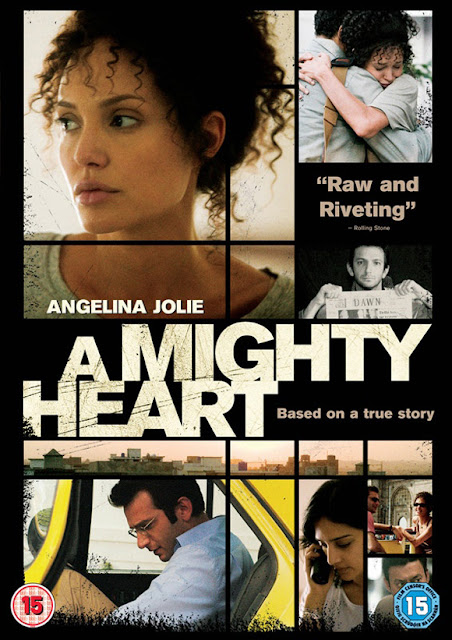
A Mighty Heart (2007) Directed by Michael Winterbottom
Nick:
The war in Iraq seems an age away now. 10 years is a long time. So much pain and loss on all sides. It's war based on a brazen lie from supposed civilized nations. Coupled with the arrogance that we are dealing with supposedly inferior people living in different cultures we dare not understand, our trail of destruction raises all kinds of moral questions. But we can afford to ignore our own moral dilemmas as our lives are enveloped in materialistic temptations and those troubles in far off continents just seem like something happening over there. Winterbottom has repeatedly tried to draw us back into messes our governments have often shirked, giving us real events dramatized in his dry/semi-documentary style if not an actual documentary. The Shock Doctrine (2009) The Road To Guantanamo(2006) Welcome To Sarajevo(1997) and A Mighty Heart all deal with war in modern times and its various repercussions. Winterbottom has form and doesn't shirk from showing the uncomfortable.
A Mighty Heart is another movie where Winterbottom manages to work with top-draw Hollywood talent on a low budget. So, amongst Winterbottom's often difficult and challenging oeuvre you'll find the likes of Jessica Alba, Colin Firth, Steve Coogan, Kate Hudson, Milla Jovovich, Kate Winslet and Woody Harrelson slumming it in often political, generally top quality, yet weird films. This time, it's Angelina Jolie, taking a trip out of her comfort zone and messing with the rough trade to show she's got the chops to be taken seriously. And she's good in A Mighty Heart. Winterbottom rein-acts the real life kidnapping and ultimate murder of Wall Street Journal journalist Daniel Pearl in Pakistan with his usual no thrills. The focus is on how Pearl's pregnant wife Mariane (Jolie) deals with the often confusing search for her husband.
Winterbottom bravely shows possible logical reasons as to Pearl's murder by Islamic fundamentalists he was supposed to interview before he and his wife were due to leave Pakistan. Was it because of Guantanamo? Because Pearl was Jewish? Repercussions for American involvement in Iraq? Supposed Wall Street Journal coercion with the CIA? Or because the Pearls housed an Indian helper who was possibly looking to discredit Pakistan? Winterbottom considers all options to the kidnapping/murder that nowadays is simply put down to an al-Qaeda killing. A Mighty Heart despite this, still works as drama. That Mariane Pearl, a journalist herself, emerges from A Mighty Heart as a human being with great compassion and willingness to understand difference in the most trying and horrific circumstances, is something we could all learn from. Up to his usual high standards, Winterbottom's picture is a powerful reminder and lesson in tolerance.
Astrid:
In 2007 there was still a sense of urgency about understanding what was really going on with the USA in Iraq, Afghanistan and the neighboring countries. I had that need too and wanted to see A Mighty Heart immediately when it came out. I did not see it, for some reason. Now, at the end of 2011 there is a deflated helplessness and resignation to all things evil – I mean that the general feeling, the media and individual people seem to be much less attuned to asking what is still going on. I'm talking about a perspective that's strictly Scandinavian, far-removed from the streets of Pakistan for example. (I imagine it impossible to not ask those questions there every day.)
In this climate watching A Mighty Heart seemed out of place. It did not feel right to view it as pure cinema, because of its depiction of real events and people. It did not seem right to view it as a superstar vehicle for Angelina Jolie either. As a movie or a series of acting performances there was nothing that impressive about the film. Yet, time had passed and the film had lost some of its political urgency, which I can imagine was shocking still in 2007.
Then again, as the end credits roll and remind you that Mariane Pearl is now living with her son in Paris, the realness of it all hits me. Despite the movie's end or the Western world's gradual disinterest in their own hateful mess, the husband and father Pearl is never coming home to his family.
This simple point should end all conflict and prove futile the logic of hatred and warfare. It seems that the Pearl family knew this and know it still, after their personal loss. It is still important to make films about what is really happening around the world – sometimes cinematic values become secondary to the need to tell the truth. Injustice will not end through ignorance.
Subscribe to:
Posts (Atom)