Wednesday, 28 September 2011

That Touch Of Mink (1962) Directed by Delbert Mann


Nick:
I could laugh at the old-fashioned attitudes towards women and homosexuality that pervade That Touch Of Mink. I could point at the fact that the picture's main obsession is sex and how to get it and how naive that seems now. But then I could tell you about what I read was happening today: the pop star Rihanna taking her clothes off in a field for her new video and how interested we are in that. Or how I read a Tweet today by RuPaul that declared "Homosexuality is found in over 450 species. Homophobia is found in only one". Or could I point out to you that as I write this, American Amanda Knox is being tried for murder in Italy and during the trial has been compared to a witch (you know, the medieval variety) with multiple personalities. So in 2011, I can attest that we have really moved on from the old fashioned sentiments of That Touch Of Mink and will view That Touch Of Mink's mild homophobia and sexism is so beneath us as to be disdainful.

In reality, the kind of film that That Touch Of Mink represents is being made regularly in 2011(with he same attitudes) and will appear at a cine-plex  near you very soon. The modern version will invariably star Jennifer Aniston as an approaching-middle-aged-woman, unmarried and looking for the incredibly wealthy and suave Mr Right (erm, Ralph Fiennes perhaps?) Sounds like a regular idea for a movie, yes? It's just that That Touch Of Mink stars Cary Grant and Doris Day, and is a star vehicle for actors who are effortless. No complications or depth in analysis needed here.

Grant retired a few years after That Touch Of Mink and Day didn't make so many more films after this either.  They are easy on the eye and ear. Professional. Mann directs like the TV journeyman he really was. This film is in many ways pointless but I still laughed out loud at a couple of gags. Doris Day really is the Queen of soft focus and Cary Grant still is the best looking man to grace a cinema screen. Light nonsense with a touch of class.

Astrid:
It's all about sex. Unbelievably so, the whole point of That Touch of Mink is the yearning to have sex and the social obstacles on the path to the bunk. Isn't it annoying when the woman wants to be married first? Isn't it funny that men get nervous too, about the first time (even Cary Grant it appears). I guess it might have been back in 1962. Now it's just silly. What could be a film about class and about the power that money brings, a satire of sorts, is finally only a comedy about the extent to which these people have to go to get some. Sex.

From the perspective of Wednesday, the 28th of September 2011 it is refreshing to remember that obsession with getting laid is not something new, something rotten poisoning the minds of us internet-housed cyborgs. We have been sex-crazy forever. At least for the last 150-something years, if Foucault is to be consulted.

That Touch of Mink is a little sinister still. It suggests that rather than being about love, hetero relationships are a transaction – money-for-your-eggs kind of thing. The most terrifying thing of all is that when the film ends with a little baby being pushed in a pram – the happy result of Doris and Cary finally making it to bed – I smile contently. Yuck.

Sunday, 25 September 2011

Raiders Of The Lost Ark (1981) Directed by Steven Spielberg


Astrid:
There was only one way to get me to sit through Raiders Of The Lost Ark again, if I could watch it with a child who has never seen it before. Sure enough, the scenario took place this weekend and  she declared it one of her favorite films. Watching movies with a child is very rewarding. They bring me to see things in a new or at least refreshed light. I was quite uncomfortable with the violence the film contains, but the child was very curious to see someone's face 'melting off', and the numerous skeletons and the snakes. She took it all as pure entertainment and went to sleep without nightmares (the only thing that was making her sick was the thought of the chocolate she'd been eating while watching the film). 

When I first saw Raiders Of The Lost Ark I was thrilled too. I think I started from the second film and was thus very impressed by the ape brain soup. It's funny how many Spielberg films left an impression on the Young-me. And how many of his movies infuriate me now. Jurassic Park was the one I went to see in a theater in 1993 – and thought it was amazing.
I must have been a less opinionated person then and more able to enjoy what life throws my way. It is an ability I struggle to connect with these days. For example, I hate James Bond. I don't have the sense of humor or the senselessness for it. I think too much, I get offended. The same goes for Indiana Jones. It's best I don't begin my analysis, because somehow I survived through the film without the Adult-me's perspective.

To get back to my safety area, I am about to curl myself on the sofa and watch a Woody Allen classic. It's going to be one that I definitely know all the lines for. Sorry Indy, don't expect to see me in your class with my eye lids batting for your attention.

Nick :
When Ingmar Bergman died a few years ago (2007),  I remember having an argument with a friend about who was more important and who would be remembered longer: Bergman or Steven Spielberg?  I think the right question might have been: should cinema make us dream and create an  escape from our daily existence, or should cinema make us reflect on the harsh realities of the human condition? Of course cinema functions as much more than just these opposites (as does the individual cinema of both Bergman and Spielberg) and ultimately any such arguments are futile. For the record, I was definitely in the Spielberg camp. I think Spielberg will live longer in people's memory (as if that matters). And furthermore, I personally prefer Spielberg's films. This says more about me than either film maker.

I've watched Raiders Of The Lost Ark countless times, it's a flawed movie for sure. But the action (which is of the roller-coaster variety) is exhausting in its excitement. There is a strong sense of humor, a Bacall-Bogart type of chemistry between the principles (Harrison Ford & Karen Allen) and at times, it's extremely violent. It also reveals Spielberg's on-screen loathing of the Nazis, a theme he would come back to in subsequent pictures. George Lucas co-produced the movie and there is always a sense here that this is two movie nerds (albeit rich ones) paying homage to an era they grew up in and the first movies they ever saw. That is key, as Raiders Of The Lost Ark displays an energy from Spielberg that he's shown since but rarely bettered. As Raiders of The Lost Ark celebrates 30 years of existence, much of what we know of as the generic action movie stems from here, but Raiders... offers so much more.

Harrison Ford gives one of his better, less resentful performances, he actually seems quite animated here. Ford's an actor who you feel expects to be in a better caliber of picture, something deeper (Bergman perhaps?) But people love him as Indiana Jones/Han Solo (or that type of wise cracking hero), so he's accepted his lot and slept through many of these type of roles, reluctantly giving the public what they want. In Raiders...he's still enthusiastic. Spielberg meanwhile continues to carve out an unpredictable filmography (with varying results). Raiders Of The Lost Ark still finds Spielberg at a time when he was more in the role of mass entertainer. For me Raiders Of the Lost Ark still shines bright as edgy, knowing entertainment and represents an early marker of greatness from one of cinema's masters.

Wednesday, 21 September 2011

Rumble Fish (1983) Directed by Francis Ford Coppola


Nick:
One of the most embarrassing things can be the older uncle who thinks he's the cool guy and still down with the kids. Getting older and clinging to youth. I often wonder if I appear like that to people. I am firmly in middle age now (45 years old). I have adult responsibilities. Yet, I have the same burning desire and enthusiasm for my favorite interests as I did when I was a teenager. Have I simply not grown up? Am I clinging to youth? I mention all this as it seems in 1983 Francis Ford Coppola made two films about street gangs that tried to appeal directly to a youthful audience. Did he feel in the early 1980's that he was no longer the young guy changing the movie industry from within (along with a whole bunch of other New Hollywood people)? Was he simply just shot after the Apocalypse Now! adventure and the flop musical One From The HeartThe Outsiders was the straighter of the two films, Rumble Fish the elegiac and one must add, more pretentious offering. Whatever the results, Coppola at least managed to introduce a roll call of new acting talent in both films that would keep movie theater's full for years to come.

As with the The Outsiders, Rumble Fish is based on S.E. Hinton's novel (she also co-scripted the movie with Coppola). This is where Rumble Fish struggles most. Frankly, the script is embarrassing. It's as if Coppola thinks it's OK if his characters spew out angst ridden cliche after cliche. This kind of dialogue may have worked in the 1950's (and especially in a Nicholas Ray movie) but by 1983 it makes Coppola look like that out of touch uncle I was talking about. But that's not all there is. You could say that the rot set in right here for Coppola as a film maker. What did he have to prove after the first two The Godfather's, Apocalypse Now! and The Conversation? Rumble Fish offers enough evidence that Coppola was actually embarking on his most experimental (if inconsistent work). Few movies from any era look as stunning as Rumble Fish. You can just ignore the terrible dialogue and bathe in the iconic imagery. You also have to factor in Mickey Rourke.

What makes Rumble Fish so fascinating now is how it captures Rourke at the height of his coolness. And he dominates Rumble Fish. Whilst everyone over acts or struggles with the material Rourke brings a calmness to proceedings, mumbling a la Brando, moody but gorgeous. Coppola nails the iconic Rourke here, on screen, in this movie. Dennis Hopper adds some Frank Booth like intensity, otherwise it's a parade of future stars and Tom Waits ( Matt Dillon, Diane Lane, Laurence Fishburne, Nichols Cage etc). Police drummer Stewart Copeland adds futuristic menace to the stunning visuals with his percussion heavy soundtrack. Rumble Fish shows Coppola trying to deal with his own mythology, growing old and trying something different. It's an uneven affair, but when it clicks, Rumble Fish can still take the breath away.

Astrid:
Yet another film about men – the angry, young and frustrated types, who simply channel their aggression into physical fights, their emotions into booze and drugs and their desire into sex. The bunch so loved by cinema, the guys that owned the last century; that's who Coppola decided to portray. He always portrays this group anyway, just think of The Godfather or Apocalypse Now. Men.

Rumble fish. Of course it's a simile. But I remember as a child watching one of these fish in its fishbowl at a neighbor's home. The girl did not have a mother and that already made me feel sorry for her. Then she had the lonely fish, which had to remain alone, because it would kill any other fish immediately. Luckily, the girl's father bought her potato chips and cereal with sugar. Those were things I was never allowed to have in my house. I had a fish tank though, with frogs even.

Back to Rumble Fish, sort of. Mickey Rourke is obviously the reason Jamie Hince looks the way he does.

That's what we figured out. Too bad I am not in my biggest The Kills fan-phase, because had I seen this movie then, I would have loved it. The look, the photography and the pretentious air would have been just fine. Now I got angry and frustrated, but I'm not a young man, so what the hell can I do?

Sunday, 18 September 2011

Lust for Life (1956) Directed by Vincente Minnelli

Astrid:
Lust For Life is a 1950s movie about an artist, or a genius, as they would have definitely branded Vincent van Gogh then. In 1956 Western culture was at a crossroads: youth culture was rearing its unreliable head threatening with rock and roll, questioning the old ways on all levels of society, yet, the portrayal of an artist was still drenched in the masculine cult of the genius (with a long romantic history to back it up). Lust For Life portrayed a rebel of his own time, but the portrayal was not drawing similarities between now and then – the plight of the social misfits – it saw van Gogh almost as if through the eyes of a child.

Also, the film treated its subject, van Gogh, as a child-like innocent creature. As if the artist was never quite aware of his talent, his persona, or anything much around him (except of course when he painted). Life just happened as a chain of events, and their arbitrary connections seemed to throw van Gogh further into insanity. It is too bad that the film's emphasis on events of his life overshadow any imagining of what the artist might have been feeling or going through in his mind. A distance between the main character and the audience thus never goes away, which is always disappointing in movies.

I have rushed excitedly to a few big museums in the world just to catch a glimpse of a "genuine van Gogh" – I love his vision, yet I know very little about the man. Of course I heard about the ear cutting and the mental illness, and the interesting fact that he was never successful and now there's nothing we cannot buy with his painting printed on it. I remember the first time I had a chance in Chicago in 1999 to go see a van Gogh and how sophisticated I thought I was – the others were going to Sealife while I went to see art. Mostly though, my love for van Gogh comes from post cards and the stuff that was written on the other side of the pictures. There's never enough time to stare at a painting in a museum.

Nick:
Twenty years since the release of Nevermind, Nirvana's mainstream grunge breakthrough album, the tortured, anguished short life of band leader Kurt Cobain comes back into focus. The consummate, non-commercial artist as young man, bringing cultured sounds to the masses. Of course, ultimately Cobain could have done without the attention and the success. He paid the heaviest price for being at the center of a media shit storm. As article after article about the Grunge explosion starts to celebrate 20 years of the quiet/loud dynamic and the rehabilitation of the plaid shirt, am I the only one having a nightmares at the prospect of a Cameron Crowe documentary celebrating 20 years of Pearl Jam? That's a bottom barrel team up if  ever I heard of one. Artist Vincent van Gogh wasn't afforded any real attention or fame during his short lifetime. Van Gogh is possibly the quintessential tortured artist, a front runner for Cobain. Eddie Vedder's got a lot to learn before being 4REAL.

There is a stiffness and quaintness to Minnelli's van Gogh bio-pic which is redolent of the times. This is its major flaw. Otherwise, Lust For Life is top quality and a genuinely strange picture posing as a Hollywood star vehicle. There is no real attempt in the film to come to terms with van Gogh's mental problems, which eventually cost him his life. Instead, we get lots of shots of Kirk Douglas (as van Gogh) looking anguished, lost and in pain. This is truly strange cinema. It's as if Minnelli gave Douglas a simple instruction: "Emote!" and left Douglas to get on with it. But the opulence of the direction (everything is in, ahem, broad strokes), the use of color, the sets and production values, all suggest money. Anthony Quinn brings energy to the picture with his portrayal of rebellious painter Gauguin.

Still, despite its shallowness and almost embarrassment with its subjects mental condition, Lust For Life is top draw. Douglas is brilliant, overacting at every turn, it's fun to watch. Minnelli knows how to use color and design: many of the shots do correlate with van Gogh's paintings. Minnelli is a master director, responsible for some of the all time greats movies, Meet Me in St. Louis, The Bad And The Beautiful, An American In Paris (in fact, a Martin Scorsese wet dream?) Lust For Life finds all participants on top form and is a classy picture, which deserves rehabilitation.

Tuesday, 13 September 2011

The Front Page (1974) Directed by Billy Wilder


Nick:
Familiarity breeds contempt. This isn't just my view, you could also level that charge at Billy Wilder with his remaking of The Front Page. This is late Wilder, taking his hands off the production mantle and just opting to co-write (with regular writing partner I.A.L Diamond) and to direct. It's a clinical yet still stylish film. You feel Wilder is here because he's got nothing better to do. Wilder and Diamond inject some cynicism, black humor and crudeness into the script, which you expect. What interests me most about The Front Page is the remake angle. This was the third time this story graced the silver screen.

I can't claim to have seen the original film version from 1931 but the not so much later retelling, going under the name His Girl Friday from 1941, is cinema gold. Howard Hawkes' 1940s remake with Cary Grant and Rosalind Russell has all the smarts and swing that Wilder's remake is lacking. Worse for me (and Astrid I feel) is that we actually watched His Girl Friday quite recently. The Front Page is an almost scene for scene remake, with some characters changing gender being the only real difference. Few films would compare favorably with His Girl Friday, so a flat, going through the motions version didn't really stand a chance.

Walter Matthau and Jack Lemon offer quality to Wilder's picture (when do they ever let you down?) as the wise and cynical newspaper men who know how to squeeze a story. Sad to say the casting of Susan Sarandon, in an early role, only highlights one of the films shortcomings. So much script time is handed over to periphery characters, which eats into the screen time and the acidic chemistry Matthau and Lemon bring to the picture. Wilder ultimately makes an OK picture. With a little more focus on the central duo, and a more elegiacal touch, Wilder could have bought in a picture with the emotional pull of his late masterpiece The Private Life Of Sherlock Holmes. Instead, The Front Page feels like it was just a job for Wilder.

Astrid:
The Front Page marks a change in the way I watch a movie: I sat knitting through the whole thing and thought to myself 'this way I can last through any boring film'. That was the point. The Front Page was a bore – especially if you had seen the previous version not so long ago and this one appeared to be an overly-faithful remake with way too little Susan Sarandon in it. Yet, through the new-found knitting, I was able to emphasize in my mind the act of sitting in a chair and really concentrating on being this woman who knits while enjoying the evening's entertainment. I could feel the calming effects of doing something repetitive with my hands and I enjoyed the sense that women have sat in comfy chairs in dimly lit rooms knitting for centuries.

From another perspective it could be asked, why is it that women who are sitting down taking a break, often have to appear to be doing something even still? Is the knitting a sign of being a dutiful wife, not wasting any precious moments? It seems like I am talking about an image from a couple centuries back... But in my case in 2011, is knitting a sign of restlessness and inability to concentrate when I used to be just fine watching a film from beginning to end with my hands in my lap? Maybe.

One solution to my frustration and lack of concentration would be to watch better movies. Recently our choices have been unlucky. The Front Page in itself is not a bad film, although I have no idea why it needed to be remade in 1974 (for the third time), still not that many decades after the original came out.
Right now I dream of going to see a film in the theater for a change. It would be luxurious. And if my hands would be occupied with anything they would be diving into a bag of candy.

Sunday, 4 September 2011

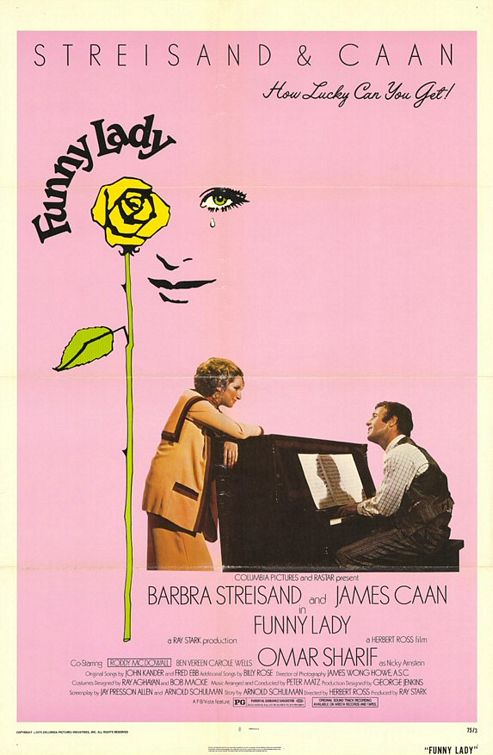
Funny Lady (1975) Directed by Herbert Ross


Astrid:
New York New York (by Scorsese) is one of my favorite movies because it tells the story of a creative couple in the period setting of musicals, big bands and elaborate hair-dos. I got a little excited then, in the first five minutes of watching Funny Lady, realizing that it might be a related film about similar subject matter. Unfortunately, despite being a 1970's film, it turned out to be a rather conservative and cheesy effort. It dealt out some promising strands of plot and lines, then taking things to nowhere interesting.

Barbra Streisand plays a successful musical star and a recording artist in the 1930's New York. She just has bad luck with men, who appear to only be interested in (her) money. Left by one of these gold diggers (Omar Sharif), she forms a working relationship with another (James Caan) and eventually, the relationship becomes more than a working one – it becomes a dysfunctional marriage. I have no clue why though, as there is obviously never infatuation, love, sex or any kind of chemistry between the two. The guy needs the rich lady to further his career. That's all.

The mid-1970s was a time of active feminist voices everywhere. It was a time when Hollywood produced some subversive cinema, even questioning the portrayal of women only as props and property. Erica Jong had a hit with her novel Fear of Flying already in 1973. In this context, Funny Lady is a poor and stuck-up movie offering a rusty vehicle to its superstar Streisand. Seeing her in almost anything else would have been more interesting than this.

Nick:
Herbert Ross is somehow related to the naming of our blog. He directed Play It Again Sam, the Woody Allen movie that quotes from the Bogart/Bacall picture The Big Sleep where we picked our blog name. Unfortunately, Ross would have a rather unremarkable career post PIAS. Funny Lady shows the director as  a yes-man to the stars, a safe pair of hands to guide the superstar vehicle: in this case, the whims and ego of Barbra Streisand. Streisand really was/is the last actress (save Lisa Minelli?) who could pull off the old-style Hollywood musical.

Funny Lady starts with promise. Although Astrid really didn't pick up on the period detail, it's one of Funny Lady's pluses for me and the movie evokes the 1930's depression era with fervor. There is also a chance that the movie will develop along the lines of Scorsese's amazing old-style musical homage New York, New York and inhabit the landscape of songwriter (James Caan) and muse (Streisand). It's sad to report that Funny Lady shies away from this at every opportunity. Instead it treads musical convention in every way with a series of uninspiring musical numbers that relate neither to plot nor charachter. It becomes very clear that this is all about Streisand and that amazing voice of hers.

Funny Lady is the sequel to Funny Girl (which I recall from my misspent youth) and does tell the real- life story of Fanny Brice (original Ziegfeld Follies girl). The first film has a certain zest, this sequel is a mess. But still, there are moments when Streisand's voice and presence carry the film and you'd hope that some substance would be given to her relationship with Caan (playing songwriter and producer Billy Rose). Caan seems to be reprising his role of Sonny in The Godfather, which considering Funny Lady is a lighthearted musical comedy, suggests he was slightly miscast. Streisand is good here but is let down by poor direction, a patchy script, flat directing and – worst for a musical – unmemorable songs. Lightweight in every sense.
Related Posts Plugin for WordPress, Blogger...